
Chef Marco Valenti spent 18 months developing the recipe that became our most celebrated dish. Here, he reveals the five principles behind perfect steak — principles that apply to everything we cook, not just beef. This is the most requested piece in our journal's history.
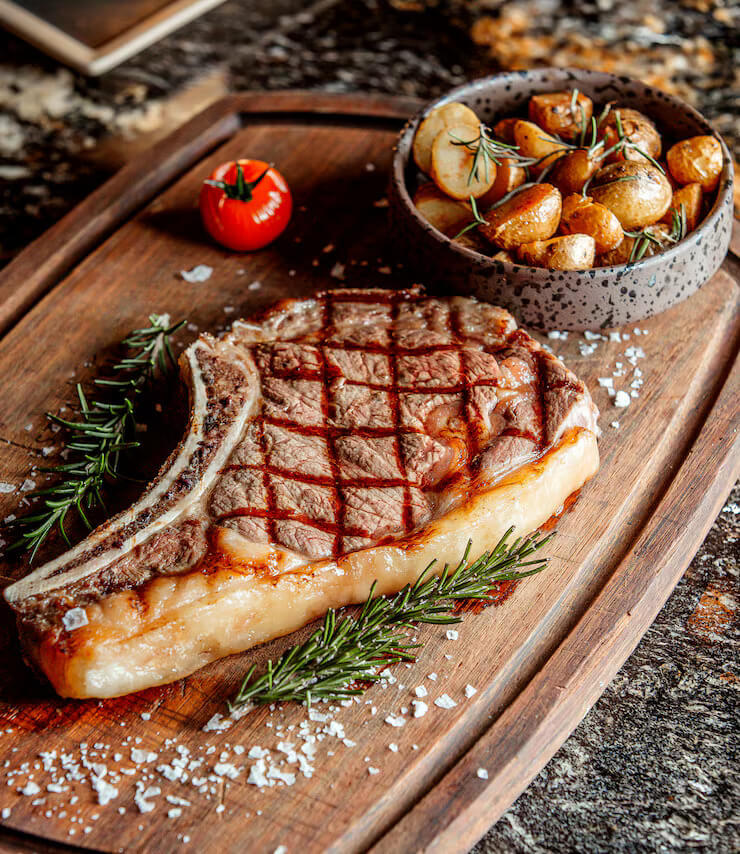
There is a moment in every service when a Wagyu ribeye hits the cast iron and the kitchen falls silent. Not because anyone asked it to — but because the sound of a properly tempered steak meeting a properly heated surface is so extraordinary that conversation simply stops. It is one of the most honest sounds in cooking. And it all begins before the steak ever touches heat.
I have cooked thousands of steaks. I have cooked bad ones, average ones, and — on perhaps a hundred occasions — genuinely extraordinary ones. The difference is never the fire. It is never the pan, the oil, or the butter. The difference is always what happened in the hours before the steak was anywhere near heat. That is the truth the restaurant industry rarely discusses openly, and it is the thing I want to talk about today.
Principle One: Temperature is Everything
A cold steak placed on a hot pan does not sear. It steams. The surface temperature drops dramatically the moment cold protein meets hot metal, and rather than developing the Maillard reaction — that complex web of amino acid transformations that creates flavour — you get a greyish, steamed piece of protein with a confused surface. The fix is simple, and yet it is the step most home cooks skip because it feels counterintuitive: rest the steak at room temperature for at least 90 minutes before cooking.
When the core of the steak is cold, heat from the pan must travel further to reach the centre. This means the outer layers overcook by the time the middle reaches the correct temperature. A room-temperature steak cooks evenly — the heat travels a shorter gradient, the surface develops its crust, and the centre achieves its target temperature at the same time. Simple physics. Extraordinary results.
Principle Two: Dry is Not a Direction — It is a Religion
Moisture on the surface of a steak is the enemy of the Maillard reaction. Water needs to evaporate before surface browning can begin, and every second your pan is spending evaporating surface moisture is a second it is not developing flavour. Pat the steak completely dry — obsessively dry — with kitchen paper before cooking. Then, if you want to go further, place the steak uncovered on a rack in the refrigerator overnight. This extended drying amplifies surface crust development dramatically.

Marco is the Head Chef and Co-Founder of Restrova. Born in Florence and trained under Michelin-starred chefs across Europe, he founded Restrova in 2012 with one goal: to cook with total honesty. He writes monthly for the Restrova Journal on technique, ingredients and the philosophy of fire-driven cooking.
The 90-minute room temperature tip completely changed how I cook steak at home. Made the Wagyu kit last weekend — the crust was unlike anything I have ever produced at home. Thank you Chef Marco.
ReplyThe section on the finishing layer finally explained why my cooking always felt like it was missing something. I have been adding things during cooking and never after. This simple shift made dinner last night genuinely restaurant-quality.
ReplyBrilliant writing. The physics explanation behind why a cold steak steams rather than sears — never seen it explained that simply. Now I cannot un-know this and I am ruined for bad steak forever.
Reply